
Last Odes on the Wing: October and November 2024

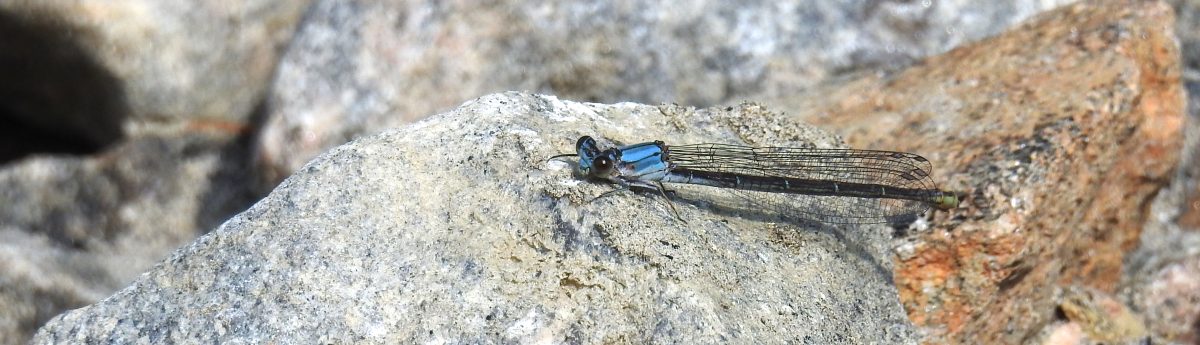
Spotted Spreadwing (Lestes congener)

Another ode season is over. Ottawa had some beautiful warm weather during the month of October – there were 26 consecutive days where the daytime high reached 9°C or above (between October 1st and 26th), tying for the 5th longest streak on record. As a result of the warm weather, I thought this would be the year I’d find more species flying later. Our first frost of the season occurred on October 16th with an overnight low of -1°C; this is a week later than the average first frost date. Then a warm spell hit late in the month – October 30th reached a ridiculous high of 22.2°C and October 31st hit 23.9°C, the warmest such days since records began in 1872. The month was mostly dry, with very little rain until the 29th.

November was cooler, though daytime temperatures remained above zero throughout the entire month. It’s not the day-time high that limits the dragonfly season in Ottawa, however; rather, it’s the nighttime lows falling below freezing. While the latest-flying dragonfly, the Autumn Meadowhawk, can withstand a few light frosts, a hard frost will kill both it and the flying insects it feeds on even if subsequent days reach double-digits. November 2nd and 3rd were both below -3°C, while November 9th and 10th were both below -2°C. A string of subzero nights after November 11th followed by warmer but cloudy, windy or wet days after November 20th ended the dragonfly season for good.

Continue reading “Last Odes on the Wing: October and November 2024”

Odonates on the wing: September 2023 Summary

Band-winged Meadowhawk

Although technically still considered summer until the equinox, the month of September ushers in the beginning of fall, the season most associated with change and impermanence, with encroaching darkness, with death and transition and the melancholy appreciation of the last burst of colour before the inevitable bleakness of winter. I can’t help but be reminded that this is the season of endings every time I go outside: the robins are gone from the neighbourhood, the songbirds in the woods have stopped singing, trees are changing colour, and the asters and goldenrods have replaced all the other wildflowers along roadsides and in conservation areas. In the dragonfly world, it is the season of the meadowhawk, the glider, and the darner, as these types of dragonflies are by far the most numerous. The goal now is to search out any others that may still be flying, and see how long into the season they last. Part of the reason is purely scientific – to get a better grasp of the flight seasons of local odonates. However, another part of the reason is purely emotional – I never know if a sighting will be the last of the year, and hope to put off the final goodbyes as long as possible.

Continue reading “Odonates on the wing: September 2023 Summary”

Next Gen Dragon-hunters

Canada Darner
Canada Darner

After I returned from my visit to southern Ontario I still had bugs on the brain, specifically odonates. Now that September has arrived the days will be getting shorter and the nights cooler, which spells the end of the season for a number of different species. It is, however, prime time for darners, and I still had yet to find a Lake Darner or Green-striped Darner this year. I also haven’t seen any Saffron-winged Meadowhawks either, another species that peaks in August and early September, despite searching known locations at the Eagleson storm water ponds. While I knew that bird migration was heating up, my brain hasn’t yet made the switch from odes to birds. I am having trouble getting up early enough to get out for my regular birding walks before work, and I won’t even consider putting my net away while the weather is still nice – I want to wring every last sunny moment looking for dragonflies and damselflies before taking the mandatory six-month winter hiatus. This has never happened to me before, and while I still am using eBird to keep track of what I see, most of my checklists are incidental ones noting only a few species that caught my attention while out later in the day dragonfly-hunting.

Continue reading “Next Gen Dragon-hunters”

The 2023 Summer Odolympics

Dragonhunter
Dragonhunter

When I first heard about the Odolympics – a special bioblitz hosted by the Dragonfly Society of the Americas, Sociedad de Odonatología Latinoamericana, and Odonata Central in order to record as many odonata species from as many places in the Western Hemisphere as possible – I knew I had to participate. This specialized bioblitz is only two years old, and there are usually two Odolympics each year: one falling during the North American summer, and one falling during the South American summer in order generate a snapshot of odonate distribution throughout both hemispheres.

Dragonflies and damselflies, collectively known as odonates, are valuable indicators of a wetland’s environmental health and biodiversity. Simply put, the more odonates that use a wetland for breeding and feeding purposes, the healthier the ecosystem. Naturalists were encouraged to submit their observations during the bioblitz via one of two platforms: iNaturalist, or Odonata Central. While I love iNaturalist and have been using it for a few years now to record my non-avian observations, I began submitting my observations to Odonata Central last year when it developed a checklist-based phone app similar to eBird. iNaturalist also has a phone-based app for submitting observations, but it is intended to be used in conjunction with the phone’s camera which I only use as a backup camera when my Nikon Coolpix’s battery decides to take a nap. Although I love the ease of searching for data in iNaturalist’s projects, I chose to record my Odolympic observations in Odonata Central as it allowed me to include observations of species for which I am usually unable to get a photo (yes, I’m looking at you, Prince Baskettail and Wandering Glider!)

Continue reading “The 2023 Summer Odolympics”

A Bluet of a Different Colour

Eastern Forktail

July is usually the start of the best three months of ode-hunting at Andrew Haydon Park. Although I often visit the park in the spring and fall for birds, my time here in the summer is devoted to dragonflies. This park is reliable for Halloween Pennants, Blue Dashers, Eastern Pondhawks, Common Green Darners, Prince Baskettails, and the usual King Skimmers, and I’ve had Cobra Clubtail and Elusive Clubtail here as well. I visited on July 29th with the hope of seeing another Cobra Clubtail, as it was on July 21, 2019 that I saw one fly into a tree on a windy day, eating what looked to be a male Orange Bluet. Though I’ve looked for both species here in July in subsequent years, I only had luck with one female Orange Bluet on July 24, 2021.

Continue reading “A Bluet of a Different Colour”

Damselflies in New Places

Violet Dancer
Violet Dancer

Damselflies are small odonates related to dragonflies, but belong to Order Zygoptera instead of Order Anisoptera. Unlike dragonflies, damselflies have very slender abdomens, and the forewing and hindwing are similar size and shape. Two of the three families found in eastern North America – the broad-winged damsels and pond damsels – hold their wings above the body, parallel to the abdomen, while perching. The third family – the spreadwings – do not perch horizontally with their wings parallel to the body, but typically “hang” from a perch, with the wings slightly spread at an angle. Adult damselflies are not strong fliers, and generally do not travel far from water. They are most often found in vegetation or on the ground near ponds, streams, and other bodies of water. Because of their small size they can be difficult to see, but the dark wings of the jewelwings and brightly coloured abdomens of some of the pond damsels help aid in observation.

Continue reading “Damselflies in New Places”

The Odes of Late Summer

Green-striped Darner (male)

By mid-August most dragonfly species are on the wane. A few families are still quite abundant, particularly the darners and meadowhawks, while small numbers of other skimmers and a few clubtails often linger into September. Forktails, bluets, and some spreadwings are also still common in the appropriate habitats in August and September. This makes it worth going out to good dragonfly habitats such as large rivers, lakes and marshes to see a decent variety of species.

Large dragonflies this time of year are particularly interesting; while Common Green Darners are the most frequently encountered large dragonflies of late summer, you might come across a Black-shouldered Spinyleg basking on the rocks along the river, a Wandering Glider zipping over a meadow, a Twelve-spotted Skimmer flying above a pond, or a group of mosaic darners swarming through the air late in the afternoon. The mosaic darners are a particular favourite of mine; they are large brownish-black dragonflies with mottled spots of blue, green or yellow depending on the sex. While they spend most of their time flying through the air hunting for small insects, I often come across them perching vertically on thick stalks of vegetation below knee-height in open grassy areas early in the morning. We have several different species in Ottawa, and trying to find something other than the ubiquitous Canada and Lance-tipped Darners is a fun exercise.

Continue reading “The Odes of Late Summer”

September Odes – A Summary

Shadow Darner

By the time September rolls around, most odonate species are done for the year in the Ottawa region – gone are the Aurora Damsels and Elegant Spreawings, the Spiny Baskettails and Ebony Boghaunters, the Arrowhead Spiketails and Horned Clubtails, the Chalk-fronted Corporals and Four-spotted Skimmers. This is the time of year when the number of meadowhawks and darners begin to peak, and southern species such as Spot-winged and Wandering Gliders may blow into our region with the warm south winds. A few bluet and spreadwing species may persist, as well as the common and widespread Eastern Forktail, though each day sees fewer and fewer individuals. This is a summary of species I saw and photographed around Ottawa during September 2019 – due to my trip to Edmonton and some cool, cloudy weekends, I didn’t visit as many places as I had hoped and missed a few common species.

Continue reading “September Odes – A Summary”

The Odes of Edmonton

Saffron-winged Meadowhawk

On September 18th I flew to Edmonton to visit my sister for a few days. Alberta is not a new province for me; my family had lived on an acreage outside of Ardrossan, which is east of Edmonton and Sherwood Park, for seven years from 1989 to 1996. As I was just teenager at the time, enduring all the drama and angst of high school, I had had no interest in nature back then – which is really too bad, as we’d lived on a small lot with a forest behind our house and a slough (a vegetated pond) across the road. When my parents and I moved back in 1996 – they to southern Ontario, via Tweed, and me and my fiancé to Ottawa – my sister remained behind, although it wasn’t until 2012 when I returned to attend her wedding.

My sister has since divorced and now lives in the north part of Edmonton, in a brand new development called Crystallina Nera. It is so new that there are no trees or gardens yet, several houses have not yet put down any sod, and houses are still being built nearby. This developments boasts a 4.8 hectare urban forest and a naturalized storm water pond, both of which I spent a lot of time exploring.

Continue reading “The Odes of Edmonton”

A Shadow at Last

Shadow Darner

The Equinox fell on Thursday, and by then the winds were blowing down from the north, putting an abrupt end to summer. Although I quite love the crisp, cool days of fall, I hate the cold early mornings which require hats and gloves to stay warm. This morning I headed out to Jack Pine Trail, leaving at 8:15 – the sun is visibly lower in the sky now – and I wished I had brought gloves as my hands were so cold. A Blue Jay and some chickadees were feeding on seeds left on the ground in the parking lot, and it seemed strange not to hear any Red-eyed Vireos or Eastern Wood-pewees singing.

Continue reading “A Shadow at Last”

Searching for Darners

I spent some time today at Bruce Pit with the hope of seeing some darners there – ever since my trip to my Dad’s trailer in southern Ontario I’d been hoping to spend more time with some of these large, lovely dragonflies in Ottawa. Mud Lake can be a good place to find them, but I’d seen none earlier this morning, so I was thinking about other places where I might find them. I recalled that Chris Traynor had found a Variable Darner late in the season last year (September 18, 2015) along the hydro cut at Bruce Pit, and decided to head there next. My plan was to spend some time near the water looking for spreadwings and skimmers, then check out the hydro cut for darners. I didn’t find much around the water other than an abundance of Lyre-tipped Spreadwings, so I headed up into the grassy area at the edge of the toboggan slope.

Continue reading “Searching for Darners”

A Lifer Dragonfly at Pinehurst Lake

Green-striped Darner

During the third week of August I spent some time at my Dad’s trailer in the Pinehurst Lake Conservation Area near Glen Morris, Ontario. Although more of a campground/recreation area than a conservation area, it is nevertheless a great spot to spend a few days and see some “southern” wildlife. The last time I was here (August 2014) I was treated to the antics of a couple of juvenile Broad-winged Hawks, found a small pond where female Black-tipped Darners laid their eggs in the late afternoon, observed a Blue-winged Warbler on a morning walk, saw my first Red-spotted Purple butterfly, and even saw a bat near one of the washroom lights after dark. I didn’t see any Broad-winged Hawks or cool southern bird species this time, but I still ended up with 28 bird species over three days – the same number I saw in 2014 – and saw several interesting odes, including a lifer!

Continue reading “A Lifer Dragonfly at Pinehurst Lake”

Andrew Haydon Park Odes

Twelve-spotted Skimmer

On July 24th I took the afternoon off work and spent it at Andrew Haydon Park. I didn’t think I’d find anything too exciting in the middle of summer, but this park is one of the few places that is easy to get to by bus from downtown (provided you don’t mind the walk from Bayshore Station up to Carling Avenue) and I figured I’d have a look around. I wasn’t planning on looking for anything in particular, as I didn’t have either my scope or my net with me; I just thought I’d enjoy the gorgeous summer afternoon outdoors and look for herons, Spotted Sandpipers, waterbirds, and whatever breeding flycatchers, vireos and swallows might be around. I really didn’t think that I would find many odonates of interest, as it’s not a place with much species diversity, but as it turned out I found myself far more entertained by them than by the birds.

Continue reading “Andrew Haydon Park Odes”