Two provinces. Six families. One unbelievable day.

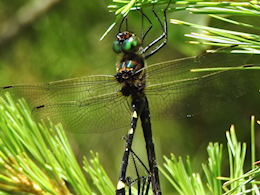
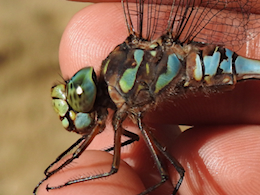
Swift River Cruiser (Macromia illinoiensis)

If you had told me it was possible to see more than a dozen Prince Baskettails hanging from the pine trees like early Christmas ornaments, three perching Swift River Cruisers (including two in a mating wheel), a perching Springtime Darner, an ovipositing Cyrano Darner, an emerging Dragonhunter, four additional clubtail species, a dozen Brush-tipped Emeralds, about 50 Widow Skimmers, and an Arrowhead Spiketail all in a single day here in the Ottawa region, I am not sure I would believe you. That kind of day is so rare in Ottawa that I would would assume that you were engaging in a particularly fanciful daydream. However, on the Quebec side of the river many things are possible. Part of it is due to the scenic geography – the deep, rocky lakes, rushing streams, and variety of marshes, swamps and bogs carved out of the Canadian Shield provide a fantastic variety of habitats. Part of it is due to the untouched wilderness outside of the Gatineau area – there are no cottages lining the shore, no subdivisions full of manicured lawns, no pesticides and insecticides to wreak havoc on insect populations. These two factors make it an excellent place to see a variety of odes – especially along the Ottawa River, a major dragonfly habitat of its own.

Continue reading “Two provinces. Six families. One unbelievable day.”

Exploring Kanata’s Creeks

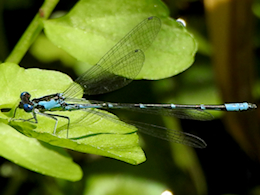
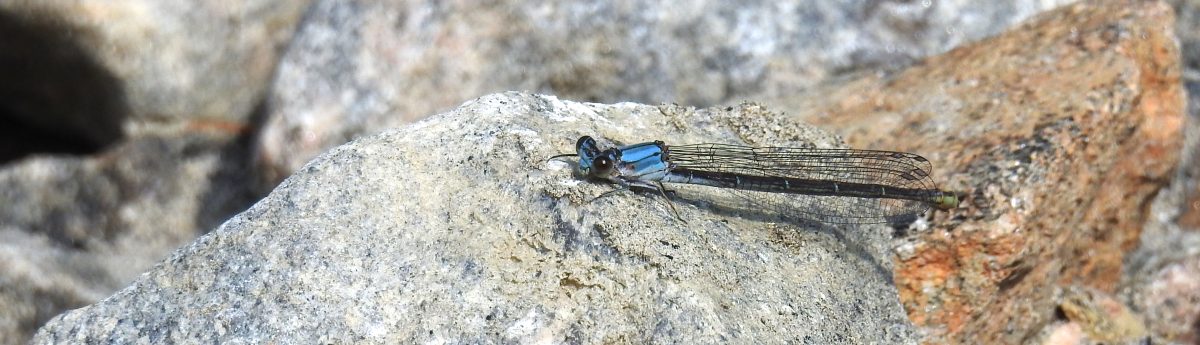
Aurora Damsel

Last November I spent some time on Google maps looking for accessible creeks around the fringes of Kanata north where I might find some creek-loving odonates. If a tiny fragment of a stream in Stony Swamp could hold Arrowhead Spiketails, who knows what other species might call these small streams home? I wasn’t expecting anything as magnificent or scarce as a Mustached or Eastern Least Clubtail, but I thought that Stream Cruisers, Fawn Darners, River Jewelwings, and maybe a spiketail might be possible.

A few areas looked particularly interesting, including a section of Shirley’s Brook between Station Road and Monk Environmental Park, the stream that drains the eastern end of the Beaver Pond near Lismer Pines Park, and Stillwater Creek where it runs between Corkstown Road and the Trans-Canada Trail, aka the Watts Creek Pathway. Although all of these streams run through green space, the surrounding areas had become built up with new homes and developments over the years. The Crystal Bay/Lakeview Park subdivision just south of Andrew Haydon Park is long-established, with a narrow band of trees running between the subdivision and Highway 417, but the area around the Beaver Pond off of Goulbourn Forced Road started being cleared for housing relatively recently (around 2010), starting with the controversial Terry Fox extension, and houses are still being built there to this day. The forest is thickest in Monk Environmental Park where there is little encroachment so far, and my hopes were highest for this little park as a result.

Continue reading “Exploring Kanata’s Creeks”

To See an Elfin Skimmer

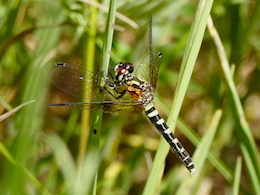
Elfin Skimmer

On Saturday, June 14, 2025 Derek Dunnett and I led a combined birding and dragonfly outing at Murphy’s Point Provincial Park for the Ottawa Field-Naturalists’ and McNamara Field Naturalists’ Clubs. It was restricted to 20 people for carpooling purposes (the park roads are quite narrow for parking) and 18 showed up altogether. Unlike our trip last year, the weather was perfect: cool and sunny in the morning, hot and sunny in the afternoon with a hint of a breeze. Our targets this year included Cerulean Warbler (which had been heard singing earlier in the week), Blue-winged Warbler, and Golden-winged Warbler, while our odonate targets included the diminutive Elfin Skimmer and various stream odonates. Last year the trip had been postponed several times due to rain, and we missed the Blue-winged Warbler, Golden-winged Warbler, and Elfin Skimmer as by the time we had visited (July 7) it was late in the breeding season and the weather for ode-hunting (thickly overcast in the morning) was less than ideal.

Continue reading “To See an Elfin Skimmer”

A Darner Kind of Day

Variable Darner (Aeshna interrupta)

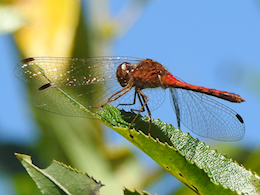
Today I went to Bruce Pit to see if anything was still flying around the edges of the pond and the field at the back. When I was here last weekend, there had still been three meadowhawk species and six damselfly species (Slender Spreadwing, Spotted Spreadwing, Azure Bluet, Familiar Bluet, Fragile Forktail and Eastern Forktail) still present, as well as an unidentified darner in flight over the water. With only two days left in the month I wasn’t expecting much, and indeed the wet vegetation at the edge of the pond yielded only three damselflies on this visit: Slender Spreadwing, Spotted Spreadwing, and Familiar Bluet. I also saw White-faced and Autumn Meadowhawks, but the Band-winged Meadowhawk from last weekend was gone.

I was pleasantly surprised when I saw at least two large darners zipping along the edge of the shore, especially when one flew low to investigate the reeds close to where I was standing. My net shot out, and the next thing I knew there was an angry buzzing sound coming from inside. I had caught a darner, and I was not really surprised to find a male Canada Darner inside.

Continue reading “A Darner Kind of Day”

Road Trip: Odes in New Brunswick

Autumn Meadowhawk

My dad, who is almost 75, has always loved to drive. He’s been talking about a road trip to the east coast for a few years now, but in August 2024 we finally did it: he, my step-mother and I left Ottawa on August 10th for a two-week road trip covering Quebec, New Brunswick, P.E.I., and Nova Scotia. We had done a similar trip when I was 12, but that trip included a ferry ride to Newfoundland to visit family on my mother’s side as well. Newfoundland is still very much in my father’s plans, and he hopes (as do I) to visit it in a year or two.

As usual, it was my goal to get some nature study and photography in, too, but I knew this trip would feature lots of time spent driving and visiting tourist attractions – my Dad wanted to revisit his previous trips there, including his time in the Navy when he was a youth stationed in Nova Scotia, while my step-mother had never been east before. And with neither of them in peak health anymore, we would have to limit our time on the trails, though there were plenty of national and provincial parks I was interested in visiting.

Continue reading “Road Trip: Odes in New Brunswick”

A Rare Mottled Darner

Mottled Darner

Sheila McKee Memorial Park has been such an amazing spot for odes this year that when the weekend called for not one, but TWO clear days, I decided it was worth going back for a few hours and looking for more clubtails. I arrived around 10:00, and as usual a dragonfly had claimed the first sunny opening in the woods as its territory – however, unlike the Common Whitetail, Racket-tailed Emerald, and Black-shouldered Spinyleg of my previous visits, this one was a brilliant green Eastern Pondhawk actively darting around and landing on different leaves. I took one terrible photo of it sitting on a leaf above head-height, facing me. This was the only pondhawk I saw, so I’m glad I got a photo for iNaturalist.

Continue reading “A Rare Mottled Darner”

A Three-Darner Day

Black-tipped Darner

On July 15th I went to Jack Pine Trail at lunch to look for dragonflies. I was hoping to find some Brush-tipped Emeralds, a species I hadn’t seen there since 2019. I have not visited Jack Pine Trail much in the past five years for a variety of reasons, including closures during the pandemic lockdowns and after the derecho of May 2022. However, the main reason is that I stopped looking for them there after I began visiting Marlborough Forest during the pandemic and saw how common the Brush-tipped Emeralds were on all the trails there. Unfortunately Marlborough Forest is a little bit too far to visit on a lunch hour, but Jack Pine Trail is nice and close. It can be good for baskettails, and it’s the most reliable spot in the area for Arrowhead Spiketails in mid-June. I’ve also had Slaty Skimmer there and two unidentified clubtails that I never got a good look at before they flew off. I usually find something interesting there when I visit, and was hoping to do so again today.

Continue reading “A Three-Darner Day”

Canada Day Clubtails – Part 1

Cobra Clubtail

On July 1st I spent the morning at Sheila McKee Memorial Park with the full intention of heading out to Pinhey’s Point afterward. My goals were to get to Sheila McKee early enough to look for the Yellow-throated Vireo and Yellow-billed Cuckoo that had been found there recently, then look for dragonflies in the open meadow and along the river shore. I was hoping to find another Mustached Clubtail, or perhaps an Arrow Clubtail, or the first Cobra or Midland Clubtails of the season. It was a bit cool in the morning, so I waited until 8:30 am to leave. When I got there just before 9:00 there were already several cars in the parking lot, and by the time I headed out to the road to listen for the elusive cuckoo a cavalcade of cars was turning into the parking lot from Sixth Line Road.

Continue reading “Canada Day Clubtails – Part 1”

Clubtail Season Begins at Sheila McKee Park

Black-shouldered Spinyleg

After a couple of wonderful outings the previous weekend, I was looking forward to heading back out to the west end to Sheila McKee Memorial Park to see if any new dragonflies had emerged. However, the weather was most uncooperative – it rained almost the entire weekend. So I took Tuesday morning off work instead, as it was forecast to be both warm and sunny…the temperature had already reached 20°C by 7:00am. My goals were still to look for rarities such as the Mustached Clubtail reported there on May 24, 2021 and the Arrow Clubtail reported there on June 24, 2021. I knew the Arrow Clubtail would be almost impossible, as it is very rare in our region, but as the Mustached Clubtail had a few sporadic reports from Remic Rapids on both sides of the Ottawa River I thought I had at least a shot of finding that species….long though it might be!

The sky was pure blue when I left, and the day’s high forecast was to be a sunny, humid 29°C – perfect weather for dragon-hunting. I left just before 9:00 so I would miss the worst of the rush hour traffic and arrived about 10:20. Being a workday, there were only two other cars in the parking lot when I arrived, and I saw no one on the beach by the time I got there.

Continue reading “Clubtail Season Begins at Sheila McKee Park”

A Dazzle of Dashers

Blue Dasher

After leaving Mud Lake I went to Sheila McKee Memorial Park to try my luck there. I was hoping that the whitefaces would still be flying, as I wanted to find some fully mature individuals after seeing so many tenerals and immatures right before my trip to the Maritimes, and I was hoping that some clubtails had emerged. It was still sunny, only about 18°C, and while the wind was still blowing, the small clearings in the woods at the top of the escarpment were relatively protected. I didn’t see any odes other than a few Powdered Dancers until I reached the main clearing where the trail leading down to the water branches off to the right. Some smaller dragonflies were perching in shrubs at the edge of the clearing, and I was delighted to find some freshly emerged Blue Dashers – both males and females!

Continue reading “A Dazzle of Dashers”

Next Gen Dragon-hunters

Canada Darner
Canada Darner

After I returned from my visit to southern Ontario I still had bugs on the brain, specifically odonates. Now that September has arrived the days will be getting shorter and the nights cooler, which spells the end of the season for a number of different species. It is, however, prime time for darners, and I still had yet to find a Lake Darner or Green-striped Darner this year. I also haven’t seen any Saffron-winged Meadowhawks either, another species that peaks in August and early September, despite searching known locations at the Eagleson storm water ponds. While I knew that bird migration was heating up, my brain hasn’t yet made the switch from odes to birds. I am having trouble getting up early enough to get out for my regular birding walks before work, and I won’t even consider putting my net away while the weather is still nice – I want to wring every last sunny moment looking for dragonflies and damselflies before taking the mandatory six-month winter hiatus. This has never happened to me before, and while I still am using eBird to keep track of what I see, most of my checklists are incidental ones noting only a few species that caught my attention while out later in the day dragonfly-hunting.

Continue reading “Next Gen Dragon-hunters”

The 2023 Summer Odolympics

Dragonhunter
Dragonhunter

When I first heard about the Odolympics – a special bioblitz hosted by the Dragonfly Society of the Americas, Sociedad de Odonatología Latinoamericana, and Odonata Central in order to record as many odonata species from as many places in the Western Hemisphere as possible – I knew I had to participate. This specialized bioblitz is only two years old, and there are usually two Odolympics each year: one falling during the North American summer, and one falling during the South American summer in order generate a snapshot of odonate distribution throughout both hemispheres.

Dragonflies and damselflies, collectively known as odonates, are valuable indicators of a wetland’s environmental health and biodiversity. Simply put, the more odonates that use a wetland for breeding and feeding purposes, the healthier the ecosystem. Naturalists were encouraged to submit their observations during the bioblitz via one of two platforms: iNaturalist, or Odonata Central. While I love iNaturalist and have been using it for a few years now to record my non-avian observations, I began submitting my observations to Odonata Central last year when it developed a checklist-based phone app similar to eBird. iNaturalist also has a phone-based app for submitting observations, but it is intended to be used in conjunction with the phone’s camera which I only use as a backup camera when my Nikon Coolpix’s battery decides to take a nap. Although I love the ease of searching for data in iNaturalist’s projects, I chose to record my Odolympic observations in Odonata Central as it allowed me to include observations of species for which I am usually unable to get a photo (yes, I’m looking at you, Prince Baskettail and Wandering Glider!)

Continue reading “The 2023 Summer Odolympics”

Quebec: Kazabazua and Beyond

Black-tipped Darner

The Common Sanddragon is one of the dragonfly species in the Algonquin Park field that is not found in the Ottawa-Gatineau region. A member of the clubtail family, it is well-marked with a mottled green and brown thorax reminiscent of a Harlequin Darner and uniquely-shaped markings down the length of the abdomen to segment 7: they look like goblets in the male, and start out as goblet-shaped in the female but gradually lose the stem. Their legs are very short for a dragonfly, and mature males have green eyes while females have gray or brown eyes. The appendages in both sexes are pale, and they are the only dragonfly in our region which has pale appendages, a mottled thorax, and brown spots at the base of each wing. Its larvae live in rivers, lakes, and streams with sandy bottoms, and due to its short legs, the adults perch horizontally on the sandy beaches and banks of its rivers rather than hanging from trees or in the vegetation. At the time of the printing of the first edition of the Algonquin field guide, it had not been recorded within the park and was only known from a few sites in Peterborough County and a single record from Windsor in Ontario’s deep south.

Continue reading “Quebec: Kazabazua and Beyond”

Identifying Green-striped and Lake Darners

Lake Darner
Lake Darner

Darner (genus Aeshna) season typically begins in July in the Ottawa-Gatineau region. The two most common mosaic darners, Lance-tipped and Canada, emerge early in the month, along with the slightly less common Shadow Darner. These three species are the most widespread members of this group, and if you see a mosaic darner flying along a forest trail or in an open clearing in the greenbelt it is most likely to be one of these. Lake Darner, Variable Darner, and Black-tipped Darner are considered “uncommon” in the Ottawa-Gatineau region, with the first being a localized species and the latter two species considered to be widespread. I suspect they may be easier to find on the Quebec side of the region, as there are more lakes and suitable bodies of water in Gatineau Park, and Black-tipped Darner has been relatively easy to find there. Finally, the Mottled Darner and Green-striped Darner are both considered “very rare”, with only a handful of records of each. I’ve been lucky to see a few Green-striped Darners in Stony Swamp in recent years, with one individual at Bruce Pit in September 2019 and two individuals at the Beaver Trail in September 2021. I’ve never seen a Mottled Darner, and hope to catch up with this species one day.

Continue reading “Identifying Green-striped and Lake Darners”

September Odes – A Summary

Shadow Darner

By the time September rolls around, most odonate species are done for the year in the Ottawa region – gone are the Aurora Damsels and Elegant Spreawings, the Spiny Baskettails and Ebony Boghaunters, the Arrowhead Spiketails and Horned Clubtails, the Chalk-fronted Corporals and Four-spotted Skimmers. This is the time of year when the number of meadowhawks and darners begin to peak, and southern species such as Spot-winged and Wandering Gliders may blow into our region with the warm south winds. A few bluet and spreadwing species may persist, as well as the common and widespread Eastern Forktail, though each day sees fewer and fewer individuals. This is a summary of species I saw and photographed around Ottawa during September 2019 – due to my trip to Edmonton and some cool, cloudy weekends, I didn’t visit as many places as I had hoped and missed a few common species.

Continue reading “September Odes – A Summary”