Fragile Forktail Confirmed!

After discovering the Saffron-winged Meadowhawks and Eastern Amberwings at the Eagleson Ponds on Sunday, July 30th, I returned again Friday after work, as well as on Saturday and Sunday. I checked the small crescent-shaped bay near the small building each time for the meadowhawks, to no avail; in fact, I didn’t see any meadowhawks on any of my visits at all. I got lucky and found one of the male Eastern Amberwings on the same mat of vegetation on Friday after work, but didn’t see any females.

I returned to the peninsula on the edge of the central pond where I had found the female spreadwing on a previous visit, but found no spreadwings on this visit. I did, however, find a tiny Fragile Forktail gliding low among the weeds, confirming this species’ presence at the ponds. I had seen one several years ago prior to the reconstruction, so I was happy to see that the population had either survived or re-established itself.

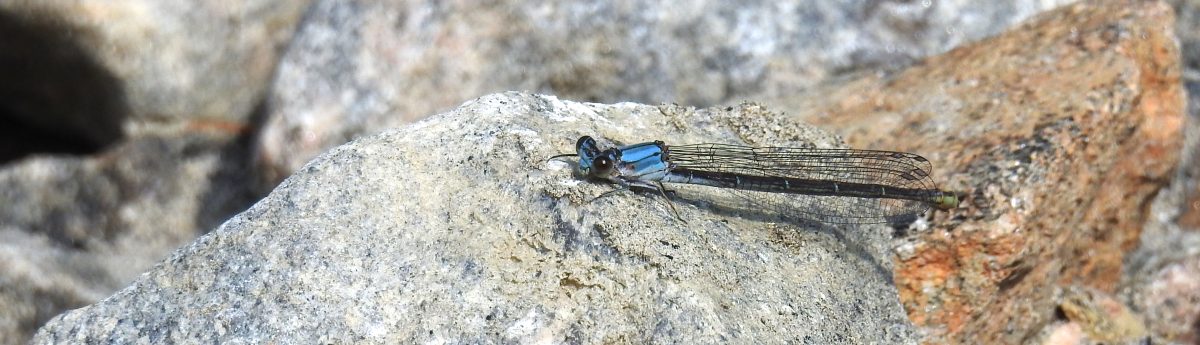
Fragile Forktail

This is a male, based on the green thorax and lack of ovipositor at the tip of the abdomen – young females are typically blue instead of green, and become bluish-gray with pruinosity as they age. Both sexes have exclamation points on top of the thorax, which distinguishes them from the more common Eastern Forktail. Male Fragile Forktails also lack the two blue spots at the tip of the male Eastern Forktail’s abdomen….the abdomen is entirely black, which makes it difficult to see flying in shaded areas.

Fragile Forktail

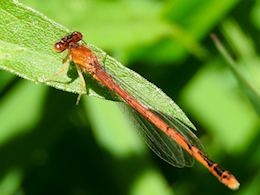
I stopped by again early on Saturday morning, which was sunnier and windier, so I didn’t see many dragonflies. There were, however, plenty of Eastern Forktails sheltering in the tall vegetation. I think this orange female is one of our prettier damselflies. Like the male Fragile Forktail, the tip of the abdomen is black when viewed from the top – it is often pale orange below. The immature Eastern Forktail is confusable only with the male Orange Bluet, which has an orange-tipped abdomen with noticeably long cerci at the end.

Eastern Forktail

My best find on Sunday was a fresh Wild Indigo Duskywing. Although I’ve been looking for them, this was my first confirmed sighting of the 2017 season. The caterpillars feed on Crown Vetch, of which there is an abundance here, particularly on the point on the east side of the pond.

I was glad to confirm that both Wild Indigo Duskywings and Fragile Forktails were still present in the area, and to see another Eastern Amberwing. The ponds have become one of my favourite birding and nature spots, and with plenty of time left in the ode season, it will be a great place for studying wildlife for the next few months!

A Lifer Dragonfly at Pinehurst Lake

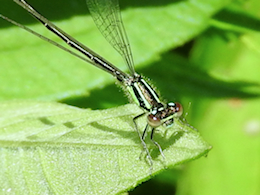
Green-striped Darner

During the third week of August I spent some time at my Dad’s trailer in the Pinehurst Lake Conservation Area near Glen Morris, Ontario. Although more of a campground/recreation area than a conservation area, it is nevertheless a great spot to spend a few days and see some “southern” wildlife. The last time I was here (August 2014) I was treated to the antics of a couple of juvenile Broad-winged Hawks, found a small pond where female Black-tipped Darners laid their eggs in the late afternoon, observed a Blue-winged Warbler on a morning walk, saw my first Red-spotted Purple butterfly, and even saw a bat near one of the washroom lights after dark. I didn’t see any Broad-winged Hawks or cool southern bird species this time, but I still ended up with 28 bird species over three days – the same number I saw in 2014 – and saw several interesting odes, including a lifer!

Continue reading “A Lifer Dragonfly at Pinehurst Lake”

Searching for Damselflies at Hurdman

Eastern Forktail (male)

On the first day of June I brought my camera to work with me and headed over to Hurdman at lunch, hoping to find some interesting butterflies and odes to photograph. Hurdman can be a very “buggy” place, so I was sure to find something interesting; at that time I still hadn’t seen my first damselflies of the year, and Hurdman is a great spot to find Eastern Forktails, Elegant Spreadwings, Powdered Dancers, Stream Bluets and Rainbow Bluets during the month of June. However, with the closure of the transitway between Hurdman and Laurier stations, as well as the detours and increased traffic on Nicholas Street resulting from the sinkhole on Rideau Street, it now takes much longer to get there so I am no longer able to spend as much time there on my lunch hour as I would like. Getting around downtown has become and adventure, and timely bus schedules have become the first casualty of all the construction.

Continue reading “Searching for Damselflies at Hurdman”

Dragon Blitz 2016 – Part II

Eastern Red Damsel

After leaving Sarsaparilla Trail I drove over to the NCC parking lot on Corkstown Road and followed the bike path beneath the Queensway to the place where Chris Traynor had seen the Eastern Red Damsels earlier in the week. The spot isn’t hard to find; just keep following the path parallel to the Queensway as it passes over a small bridge and skirts the northern edge of a farmer’s field. Eventually the path reaches a small woodlot and abruptly turns south; before you get to the small stand of trees, watch for an NCC sign on the left about the crops of the Greenbelt. Chris had found the damselflies in the grass behind the sign.

Continue reading “Dragon Blitz 2016 – Part II”