On July 1st I spent the morning at Sheila McKee Memorial Park with the full intention of heading out to Pinhey’s Point afterward. My goals were to get to Sheila McKee early enough to look for the Yellow-throated Vireo and Yellow-billed Cuckoo that had been found there recently, then look for dragonflies in the open meadow and along the river shore. I was hoping to find another Mustached Clubtail, or perhaps an Arrow Clubtail, or the first Cobra or Midland Clubtails of the season. It was a bit cool in the morning, so I waited until 8:30 am to leave. When I got there just before 9:00 there were already several cars in the parking lot, and by the time I headed out to the road to listen for the elusive cuckoo a cavalcade of cars was turning into the parking lot from Sixth Line Road.
After a couple of wonderful outings the previous weekend, I was looking forward to heading back out to the west end to Sheila McKee Memorial Park to see if any new dragonflies had emerged. However, the weather was most uncooperative – it rained almost the entire weekend. So I took Tuesday morning off work instead, as it was forecast to be both warm and sunny…the temperature had already reached 20°C by 7:00am. My goals were still to look for rarities such as the Mustached Clubtail reported there on May 24, 2021 and the Arrow Clubtail reported there on June 24, 2021. I knew the Arrow Clubtail would be almost impossible, as it is very rare in our region, but as the Mustached Clubtail had a few sporadic reports from Remic Rapids on both sides of the Ottawa River I thought I had at least a shot of finding that species….long though it might be!
The sky was pure blue when I left, and the day’s high forecast was to be a sunny, humid 29°C – perfect weather for dragon-hunting. I left just before 9:00 so I would miss the worst of the rush hour traffic and arrived about 10:20. Being a workday, there were only two other cars in the parking lot when I arrived, and I saw no one on the beach by the time I got there.
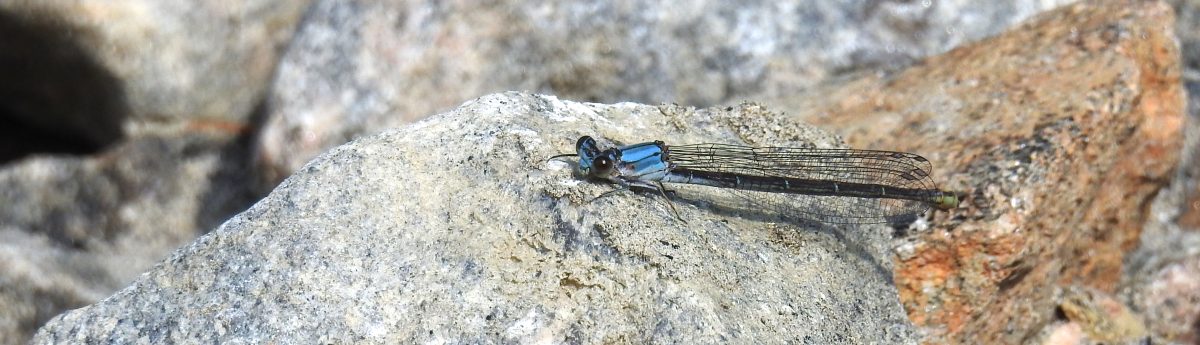
After leaving Mud Lake I went to Sheila McKee Memorial Park to try my luck there. I was hoping that the whitefaces would still be flying, as I wanted to find some fully mature individuals after seeing so many tenerals and immatures right before my trip to the Maritimes, and I was hoping that some clubtails had emerged. It was still sunny, only about 18°C, and while the wind was still blowing, the small clearings in the woods at the top of the escarpment were relatively protected. I didn’t see any odes other than a few Powdered Dancers until I reached the main clearing where the trail leading down to the water branches off to the right. Some smaller dragonflies were perching in shrubs at the edge of the clearing, and I was delighted to find some freshly emerged Blue Dashers – both males and females!
On June 15th I visited Mud Lake for a morning of birding and ode-hunting. It was about 13°C when I arrived at 8:30, and although it was sunny, the persistent breeze made it feel cooler. Still, there were more odes about than I had hoped for, although at first I saw only a few damselflies (Eastern Forktails, Fragile Forktails and Powdered Dancers) and Dot-tailed Whitefaces. It wasn’t until about an hour into my walk that I came across my first interesting odonate observation of the day: a lilac bush with several dragonflies perching on its branches. It was the Spiny Baskettail landing on an exposed twig that caught my attention, and while I was trying to photograph it a few more dragonflies landed nearby: first a Blue Dasher and then a Prince Baskettail! These large emeralds are the least likely of the baskettails to land, so seeing one perching is always a treat.
Late spring is a wonderful time to visit Sarsaparilla Trail. I usually start visiting in May to look for early dragonflies such as Spiny Baskettails and Chalk-fronted Corporals, both of which emerge in good numbers in mid- to late May. It is also a good place to look for Taiga Bluets, often my first damselfly of the year. Friday, May 24th was a beautiful, sunny day despite a cool north wind blowing, so I spent my lunch hour there searching for signs of spring. I began my walk by scanning the shrubs bordering the clearing near the outhouse for dragonflies perching in the vegetation and baskettails flying in the open…there were no emeralds flying on my visit, although there had been over a dozen Spiny Baskettails present only eight days earlier. I did scare up a dragonfly perching close to the ground – it turned out to be a Four-spotted Skimmer.
We arrived in Moncton late on Wednesday, June 5th. Our AirBNB for this stay was a basement unit in Riverview, the small town situated on the south side of the Petitcodiac River and a short drive from both downtown Moncton and the Moncton Coliseum, home of East Coast Comic Expo. I had already scouted a few places that looked good for both birding and and ode-hunting; these included Riverview Marsh contained within a bend of the Petitcodiac River for Nelson’s Sparrow, Mill Creek Nature Park for forest birds and stream dragonflies, Bell Street Marsh for marsh birds and odes, and a small stream in a hydro corridor near Mill Creek for Superb Jewelwing, a potential lifer for me.
By October I’m thinking about putting the net away for the season. If it is still warm at the beginning of the month, I will usually take the net out as long as I’m still seeing darners and small bluets around. Once I’m seeing nothing but meadowhawks, however, it’s time for me to declare an end to the season and put my gear away until the spring. This year the first week of October was very warm, with temperatures reaching 30°C; they then returned to seasonal for the next week with temperatures in the mid-teens. By the end of the month temperatures were in the single digits during the day and falling to below zero overnight, bringing an end to all but the hardiest of dragonflies. That title belongs to the meadowhawks, in particular the Autumn Meadowhawk (Sympetrum vicinum). It is no coincidence that it is the latest-flying dragonfly in many areas of the northeast….sometimes by several weeks. Once called the Yellow-legged Meadowhawk, it was renamed in 2004 by the Dragonfly Society of the Americas because mature individuals often have brown legs instead of yellow and because it persists so long into the fall. It is the only dragonfly in our area with entirely brown or yellow legs (never black), making identification relatively easy. And it is the only species you are likely to see in Ottawa in November!
Although technically still considered summer until the equinox, the month of September ushers in the beginning of fall, the season most associated with change and impermanence, with encroaching darkness, with death and transition and the melancholy appreciation of the last burst of colour before the inevitable bleakness of winter. I can’t help but be reminded that this is the season of endings every time I go outside: the robins are gone from the neighbourhood, the songbirds in the woods have stopped singing, trees are changing colour, and the asters and goldenrods have replaced all the other wildflowers along roadsides and in conservation areas. In the dragonfly world, it is the season of the meadowhawk, the glider, and the darner, as these types of dragonflies are by far the most numerous. The goal now is to search out any others that may still be flying, and see how long into the season they last. Part of the reason is purely scientific – to get a better grasp of the flight seasons of local odonates. However, another part of the reason is purely emotional – I never know if a sighting will be the last of the year, and hope to put off the final goodbyes as long as possible.
After I returned from my visit to southern Ontario I still had bugs on the brain, specifically odonates. Now that September has arrived the days will be getting shorter and the nights cooler, which spells the end of the season for a number of different species. It is, however, prime time for darners, and I still had yet to find a Lake Darner or Green-striped Darner this year. I also haven’t seen any Saffron-winged Meadowhawks either, another species that peaks in August and early September, despite searching known locations at the Eagleson storm water ponds. While I knew that bird migration was heating up, my brain hasn’t yet made the switch from odes to birds. I am having trouble getting up early enough to get out for my regular birding walks before work, and I won’t even consider putting my net away while the weather is still nice – I want to wring every last sunny moment looking for dragonflies and damselflies before taking the mandatory six-month winter hiatus. This has never happened to me before, and while I still am using eBird to keep track of what I see, most of my checklists are incidental ones noting only a few species that caught my attention while out later in the day dragonfly-hunting.
My mother lives in Wallaceburg in Chatham-Kent, which is about a 7.5 hour drive from Ottawa, or a full day train adventure with a transfer in Toronto (my advice for anyone travelling economy on Via: take your own sandwiches and snacks, as the menu was somewhat unpalatable…and chocolate bars/chips alone were $3.00). Being so far south she gets a variety of birds, bugs and plants that we do not get here in eastern Ontario, so I’ve been meaning to visit in the summer when I might see some new southern butterflies and dragonflies for my life list. I took an extra two days off at the end of August so I could spend the Labour Day long weekend with her, though two of the days were lost to travel. As my mother and her husband both enjoyed birds and nature, I knew they’d be interested in taking a few nature walks with me, even if the idea of looking for dragonflies didn’t exactly fill them with delight.
When I first heard about the Odolympics – a special bioblitz hosted by the Dragonfly Society of the Americas, Sociedad de Odonatología Latinoamericana, and Odonata Central in order to record as many odonata species from as many places in the Western Hemisphere as possible – I knew I had to participate. This specialized bioblitz is only two years old, and there are usually two Odolympics each year: one falling during the North American summer, and one falling during the South American summer in order generate a snapshot of odonate distribution throughout both hemispheres.
Dragonflies and damselflies, collectively known as odonates, are valuable indicators of a wetland’s environmental health and biodiversity. Simply put, the more odonates that use a wetland for breeding and feeding purposes, the healthier the ecosystem. Naturalists were encouraged to submit their observations during the bioblitz via one of two platforms: iNaturalist, or Odonata Central. While I love iNaturalist and have been using it for a few years now to record my non-avian observations, I began submitting my observations to Odonata Central last year when it developed a checklist-based phone app similar to eBird. iNaturalist also has a phone-based app for submitting observations, but it is intended to be used in conjunction with the phone’s camera which I only use as a backup camera when my Nikon Coolpix’s battery decides to take a nap. Although I love the ease of searching for data in iNaturalist’s projects, I chose to record my Odolympic observations in Odonata Central as it allowed me to include observations of species for which I am usually unable to get a photo (yes, I’m looking at you, Prince Baskettail and Wandering Glider!)
The Common Sanddragon is one of the dragonfly species in the Algonquin Park field that is not found in the Ottawa-Gatineau region. A member of the clubtail family, it is well-marked with a mottled green and brown thorax reminiscent of a Harlequin Darner and uniquely-shaped markings down the length of the abdomen to segment 7: they look like goblets in the male, and start out as goblet-shaped in the female but gradually lose the stem. Their legs are very short for a dragonfly, and mature males have green eyes while females have gray or brown eyes. The appendages in both sexes are pale, and they are the only dragonfly in our region which has pale appendages, a mottled thorax, and brown spots at the base of each wing. Its larvae live in rivers, lakes, and streams with sandy bottoms, and due to its short legs, the adults perch horizontally on the sandy beaches and banks of its rivers rather than hanging from trees or in the vegetation. At the time of the printing of the first edition of the Algonquin field guide, it had not been recorded within the park and was only known from a few sites in Peterborough County and a single record from Windsor in Ontario’s deep south.
July is usually the start of the best three months of ode-hunting at Andrew Haydon Park. Although I often visit the park in the spring and fall for birds, my time here in the summer is devoted to dragonflies. This park is reliable for Halloween Pennants, Blue Dashers, Eastern Pondhawks, Common Green Darners, Prince Baskettails, and the usual King Skimmers, and I’ve had Cobra Clubtail and Elusive Clubtail here as well. I visited on July 29th with the hope of seeing another Cobra Clubtail, as it was on July 21, 2019 that I saw one fly into a tree on a windy day, eating what looked to be a male Orange Bluet. Though I’ve looked for both species here in July in subsequent years, I only had luck with one female Orange Bluet on July 24, 2021.
The morning of July 18th was warm and cloudless, so we resumed our search for rushing creeks, waterfalls, and odes. I had noticed one spot on Google maps that wasn’t too far from us – Slokum Brook Falls, just north of the Trans-Canada Highway. Photos showed a nice little brook with a steep waterfall in the middle of the woods, and reviews on Alltrails.com indicated that it was a bit difficult to find, as it is very overgrown at the beginning. It is said to be the highest falls on the North Mountain that drains into the valley, though there is really only water here during the spring runoff. We drove down Lily Lake Road, slowing down once we got past the lake itself. I peered into the dense foliage along the road, and found only two spots that looked like trails entering the woods, though both had “private property” signs at the entrance. Once the forest opened up we realized we must have gone past it, and decided to turn around at the end of the road, which elbowed north onto Douglas Road as the woods gave way to farm fields.
I wasn’t expecting to find a new species for the Eagleson storm water ponds when I went there this morning, let alone two; my main goal was to look for some Rainbow Bluets in the vegetation around the southern-most pond. My walk started normally enough, with the usual odonates perching in the vegetation: Taiga Bluets, Eastern Forktails, Sedge Sprites, and even a Fragile Forktail. I headed out onto the small spit of land where I used to see Saffron-winged Meadowhawks and Eastern Amberwings perching over the water before the sparse planting of cattails became a solid, impenetrable wall of vegetation. There was one dragonfly here, and I caught a glimpse of the black and white colours as it landed on the ground ahead of me. It was Chalk-fronted Corporal, and at first I thought nothing of it as I snapped a few photos for my iNaturalist project. After all, these dragons were not only common, but also abundant where they happened to emerge. It took me a moment to realize that although I see them quite regularly at Sarsaparilla Trail and in Marlborough Forest, I had never seen one here at the ponds before. It was a new species for my project!
Chalk-fronted Corporal (Ladona julia)
I only saw one as I made my way around the southern-most pond, but then I didn’t have time to check any of the others. Would it be a one-time visitor, like the Racket-tailed Emerald of 2022 or the Violet Dancer of 2020? Or would more follow? I’d seen a noticeable decline in skimmer numbers over the last year or two, so new additions were definitely welcome. There are fewer Common Whitetails, Twelve-spotted Skimmers, Widow Skimmers, Eastern Pondhawks and Dot-tailed Whitefaces around the edges of the ponds than there used to be. While none of these had ever been truly abundant, I would usually see a few on most visits in appropriate weather. I suspect the large number of fish – particularly carp, which feed by disturbing the wetland floor and stirring up sediment containing dragonfly larvae – and growing number of frogs and toads are likely responsible for this decline, but have no evidence to support this theory.
I found some Rainbow Bluets in the vegetation right where I expected them – they seem to prefer the western side of the southern pond – and was reassured when I saw a Common Whitetail a little later, flying over the small J-shaped pond next to the rock bridge before landing on a bare patch of ground sloping down to the water. I was making my way around the pond back to my car, looking for pondhawks basking on the rocks when something black fluttered in the vegetation below me. When I identified it as a male River Jewelwing I was astonished, as this was a species I never expected to find here at the ponds.
River Jewelwing (Calopteryx aequabilis)
River Jewelwings live along medium-sized streams and small rivers with a slow to moderate current and plenty of submergent vegetation. They prefer more open waterways with more sunlight than Ebony Jewelwings, though the two species are often found together along wooded streams. The closest places I’ve seen River Jewelwings are the stream at the back of Jack Pine Trail in Stony Swamp (which I call Spiketail Creek), and Stillwater Creek at Corkstown Road just east of Moodie Drive. The former was a one-time visitor, while the latter was seen during an exploratory excursion in 2015 with Chris Traynor after I saw one away from the water across the road in 2011.
There is a small channel of water that runs south from the Eagleson storm water pond system through farmland before reaching the Jock River at Terry Carisse Park. It has enough of a current to keep it open during mild winters, and I suppose it is just as likely that the River Jewelwing flew up the channel as it is that it flew or was blown south from Stillwater Creek. It’s a mystery as to where it came from and where it was going when it found the ponds, and I expect this to be a one-time visit rather than the harbinger of a new population of River Jewelwings at the ponds.
As I was photographing the jewelwing I saw two Common Green Darners fly by in tandem. This species is common at the ponds, and I usually see one or two patrolling the shoreline every visit in the first couple of months of the season. The pair stopped so the female could lay her eggs, inserting the tip of her abdomen into the water while still connected to the male:
Common Green Darners (Anax junius)
It is always fun adding new species to my project, especially if they become permanent residents: the larger the number of residents, the healthier the ecosystem. Dragonflies and damselflies in particular are good bioindicators of water quality and the health of a wetland, as they require clean water in which to grow as larvae and survive to adulthood. Given that the purpose of the storm water ponds is to collect poor-quality runoff from the surface of the city streets, which often contains road salt, vehicle fluids, bacteria, fertilizers, pesticides and other pollutants, I had my doubts whether these ponds could support a vibrant population of dragonflies. However, with recent additions such as the Orange Bluet, Eastern Amberwing and Band-winged Meadowhawks, whose populations seem to be stable, it seems that the water quality is in fact high enough to allow these species to thrive.
My informal list stands at 35 species as of June 2023, which is the same number as the species recorded on the iNaturalist project, though with two differences: I don’t count the single record of Hagen’s Bluet which shows up there, as the photos do not show sufficient detail for me to identify it; and I do count Prince Baskettail which is not in iNaturalist, as I have seen many but have not been able to photograph or catch one. I don’t count the Northern/Sweetflag Spreadwings which I’ve seen but haven’t been able to catch, either, since identification requires a close view of the male’s claspers….all goals for future visits!
So what species will turn up here next? I’m thinking Powdered Dancer or Halloween Pennant are most likely, but with dragons and damsels one just never knows. As my mentor says, odes – just like birds! – have wings and can turn up anywhere!



 OdoNotations